 ultimate-guide
Best Roof Rejuvenation in Utah: Costs, Lifespan & Results
Discover how Utah's climate impacts asphalt shingle roofs, what roof rejuvenation costs, how long it lasts, and when restoring your roof may be a smart alternative to replacement.
Table of Contents
- Why Utah Roofs Face Unique Stress
- What Roof Rejuvenation Actually Does
- Signs Your Roof Needs Rejuvenation Instead of Replacement
- Roof Rejuvenation vs Replacement: Which Makes Sense
- How Long Does Roof Rejuvenation Last?
- Asphalt Shingle Restoration Cost: What Drives the Price
- Compatibility, Insurance, and HOA Considerations
- Maintaining Your Roof After Rejuvenation
- Frequently Asked Questions
Last Updated: September 10, 2026
Why Utah Roofs Face Unique Stress
Most roof rejuvenation content treats climate as a footnote. That is a mistake here: the environmental load is measurably harsher than what shingle manufacturers design their baseline service life around, and that difference is why rejuvenation is worth considering instead of replacement.
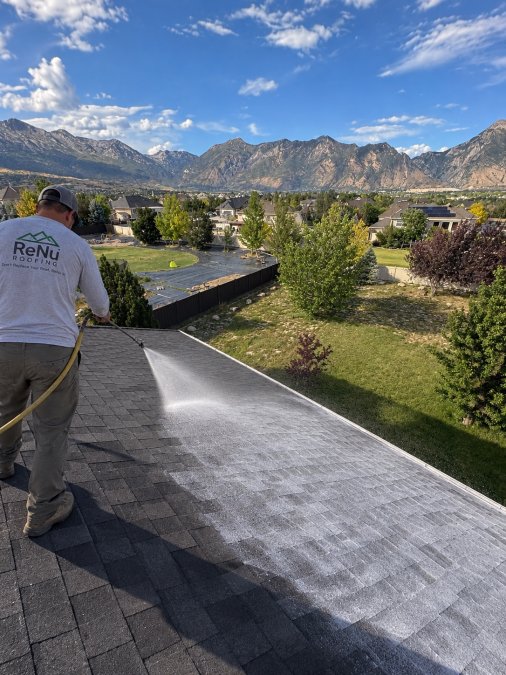
Roofing technician applying a spray treatment for roof rejuvenation to asphalt shingles on a sunny day
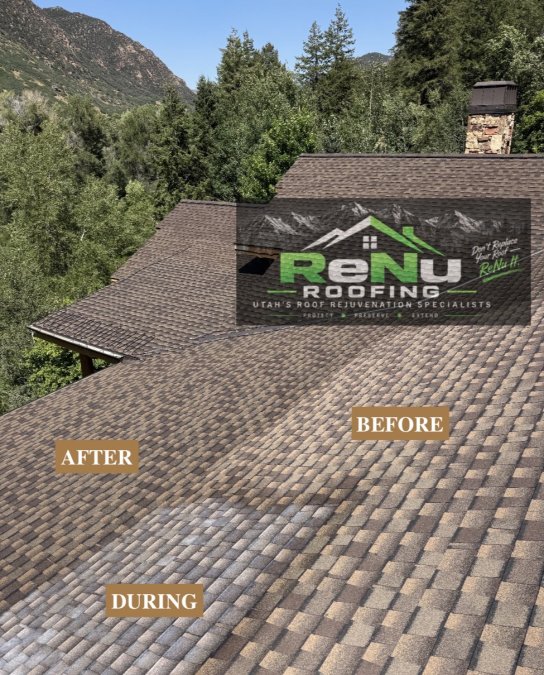
We rejuvenated this Utah mountain roof to restore shingle flexibility and help protect against harsh mountain weather and intense UV exposure.
The altitude multiplier on UV
Elevation is the biggest factor most homeowners never think about. UV intensity climbs roughly 10 to 12 percent per 1,000 meters of elevation gain, and much of the state's population lives above 4,000 feet (the EPA). Shingles here absorb meaningfully more ultraviolet energy per sunny day than the same shingles at sea level.
UV does not just fade color. It attacks the asphalt binder, driving oxidation that strips flexible oils from the mat. Once those oils are gone, the shingle stops flexing and starts cracking, the dry, brittle feel inspectors flag on roofs only 10 to 15 years old.
Thermal shock, not just heat
A shingle roof expands in the afternoon sun and contracts hard after sunset. In high-desert conditions, a roof surface can swing 50 to 70 degrees Fahrenheit between a summer afternoon and the following pre-dawn hours (weather.gov). Over thousands of those cycles, microcracks open at the stress points, nail lines, ridge caps, and tab edges.
This is why a roof can look intact from the street and still be failing at the material level. The damage is cumulative and invisible until granules start shedding.
Freeze-thaw is the finisher
Winter adds a second mechanism. Moisture in those microcracks freezes overnight, expands, and pries the crack wider; when it thaws, more water gets in. Repeat that across a winter and the moisture barrier degrades from the inside out, the same freeze-thaw process that cracks concrete and heaves roads.
Hail and wind load the weakened structure
Spring and summer storms add impact and uplift stress to shingles already less flexible than when new. A shingle that shrugged off hail in year three can crack or tear in year twelve, not because the hail was worse, but because it had less give left.
What this means for your decision
Put those four forces together: shingles here age on an accelerated clock but reach the 'weathered but structurally sound' stage earlier, exactly the window where rejuvenation delivers the most value. A roof that lasts 25 years in a milder climate may be a candidate for rejuvenation much earlier in Utah—sometimes around 12–15 years—provided the shingles, roof deck, and flashing remain in suitable condition.
What Roof Rejuvenation Actually Does
Roof rejuvenation is a treatment that restores flexibility and reduces granule loss in aging asphalt shingles, extending roof life without a full tear-off. It is not a paint or cosmetic coating: a proper treatment works at the shingle level, replenishing the protective oils UV exposure and oxidation strip away.
How the Treatment Process Works
The process starts with a roof assessment: a contractor inspects for structural integrity, active leaks, and damage that would rule out restoration. If the roof qualifies, the sequence runs like this:
- Clean the surface. Debris, leaves, pine needles, moss, etc.
- Inspect and replace. We identify and repair damaged or missing shingles, nail pops, loose shingles, cracked pipe boots, and any other area of concern before applying the rejuvenation treatment.
- Apply the rejuvenating treatment. A plant-based treatment penetrates the shingle, restoring flexibility and slowing further granule loss.
Signs Your Roof Needs Rejuvenation Instead of Replacement
The clearest sign is a roof that is aging but still structurally sound. If shingles are losing granules, feel dry or brittle, or show early curling, but the deck is solid and there is no widespread water intrusion, rejuvenation is worth evaluating before you commit to a tear-off.
Watch for these indicators:
- Granule loss collecting in gutters
- Shingles that crack or snap when bent
- Curling shingles at edges and ridges
- Fading or darkening from UV exposure
- A roof that is older but has never leaked
A roof inspection is the only way to confirm which category you fall into. The decision is not "old versus new" but "structurally sound but weathered" versus "structurally compromised."
Roof Rejuvenation vs Replacement: Which Makes Sense
For a sound roof with surface aging, rejuvenation is the cost-effective alternative to replacement. It restores flexibility, reduces granule loss, and adds a protective layer without the waste and disruption of a tear-off.
Factor | Roof Rejuvenation | Full Replacement |
|---|---|---|
Best for | Structurally sound, aging roofs | Widespread damage or leaks |
Roof life extension | 5-15 years | Full new service life |
Landfill waste | Very Minimal | High |
Disruption | Low | High |
Warranty | 6-year transferable (ReNu Roofing) | Varies by installer |
When Replacement Is the Right Call
Replacement wins when the roof is past saving. Active leaks across multiple areas, soft or sagging decking, and shingles that crumble on contact all point to a roof needing more than restoration, no treatment fixes structural compromise.
Be skeptical of a replacement quote that never mentions restoration. Accepting a full-replacement recommendation without a second opinion is a common mistake, especially when the roof still has good bones.
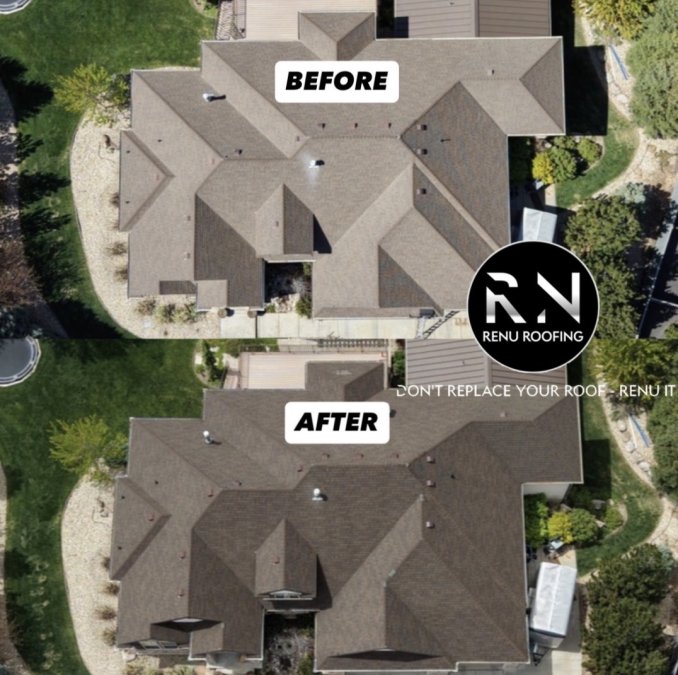
This 15-year-old Utah roof was rejuvenated by ReNu Roofing. Helping extend its lifespan for many years to come at a fraction of the cost of replacement.
How Long Does Roof Rejuvenation Last?
Roof rejuvenation typically extends roof life by 5 to 15 years, depending on the roof's condition, the climate, and post-treatment maintenance. A roof treated early, before damage sets in, tends to land at the longer end of that range.
Longevity depends on three things: the starting condition of the shingles, the quality of the treatment, and post-treatment maintenance. A roof already saturated with moisture or riddled with microcracks will not last as long as one treated at the first sign of granule loss.
ReNu Roofing backs its rejuvenation services with a 6-year transferable warranty, and its protective coatings carry a 20-year warranty. That transferable coverage matters if you plan to sell: the warranty moves to the new owner rather than dying with your ownership.
Schedule Your FREE Roof Inspection →
Asphalt Shingle Restoration Cost: What Drives the Price
Every competitor page promises 'savings' without a number. The honest version: rejuvenation is priced per project, but the gap between restoration and replacement is large enough to change the math for most homeowners, so understand what moves that gap before you take a quote.
The headline comparison
A full asphalt shingle tear-off and replacement can be a significant investment, depending on pitch, layers, decking condition, and whether underlayment and flashing are replaced (energy.gov). Rejuvenation is priced as a fraction of that, as it avoids the costs associated with tear-off, dumpster rental, new shingle bundles, and extensive labor.
That is why restoration is often described as saving a substantial percentage of a replacement bill rather than a flat dollar figure. The exact percentage depends on your roof, any provider quoting a firm price over the phone without an inspection is guessing.
What actually drives your price
- Roof size (squares): Material and labor scale directly with square footage. A 2,000-square-foot roof is not twice a 1,000-square-foot roof in cost, but it is close.
- Pitch and height: Steep pitches and multi-story roofs require more safety equipment, slower work, and more labor hours. This is often the biggest single swing factor.
- Roof condition and prep: Heavy granule loss, moss, algae streaking, or debris can require additional cleaning and prep. Damaged or missing shingles and necessary repairs must be addressed before treatment.
- Number of roof planes and complexity: Hips, valleys, dormers, and multiple penetrations add time and material.
- Treatment type: A shingle rejuvenation treatment and a flat-roof reflective coating are different products at different price points. Do not compare them as if they were the same service.
- Access: Tight lots, landscaping, and fence lines can slow a crew and add cost.
The costs rejuvenation avoids
The savings are not just the treatment price. Replacement carries costs that never appear on the shingle line item:
- Tear-off and disposal: Removing old shingles and paying landfill tipping fees.
- Decking repair: Any soft or rotted sheathing found under the old roof must be replaced.
- Underlayment, flashing, and ventilation: Often upgraded during a replacement.
- Permits and inspections: Many jurisdictions require a permit for a full re-roof.
- Disruption and landscaping damage: Crews, dumpsters, and nails in the yard.
Rejuvenation skips most of that list. That is where the real savings live.
How to read a quote
Ensure the quote includes even, full roof rejuvenation coverage. Any additional costs for shingle replacements, repairs, or other services should be clearly listed separately.
Financing and timing
Because restoration can be a cost-effective alternative to replacement, many homeowners find it a manageable expense. If you are considering financing, ask whether the provider offers a payment plan and compare the total plan cost against paying outright. Treating a roof in the earlier stages of weathering can often cost less than waiting, since less prep and repair work may be needed. Deferred maintenance does not save money, it shifts the cost to a larger job later.
For a project-specific number, request an inspection and a written quote rather than relying on a generic estimate.
Compatibility, Insurance, and HOA Considerations
Not every roof is a candidate for rejuvenation. Before treatment, it’s important to confirm that your asphalt shingles are in suitable condition and check for any insurance or HOA requirements.
Roof Eligibility Checklist:
Asphalt shingles are intact and suitable for treatment.
No active leaks, soft decking, or major structural damage.
Granule loss or aging is present but not severe enough to require replacement.
Insurance & HOA Considerations
Some insurance companies consider roof age and condition when reviewing coverage or renewal eligibility. Keeping records of roof rejuvenation and any applicable warranty may help document maintenance, but it does not guarantee insurance approval or continued coverage.
HOAs may also have requirements regarding roofing materials, color, and appearance. Check your community’s guidelines before scheduling treatment to ensure your project meets any applicable requirements.
Maintaining Your Roof After Rejuvenation
Post-treatment maintenance protects your investment. A rejuvenated roof still needs routine care to hit the longer end of its lifespan.
Schedule preventative maintenance that includes:
- Gutter cleaning to prevent roof saturation and water backup
- Gutter guard installation to keep debris out
- Annual roof inspections to catch new damage early
- Prompt repair of any lifted or damaged shingles
This is where many homeowners drop the ball: the treatment buys you years, but neglect gives them back. Pairing rejuvenation with ongoing maintenance protects curb appeal, structural integrity, and the warranty itself.
Utah's climate will keep testing your roof, and the choice between restoring and replacing is rarely as obvious as a contractor's quote makes it sound. ReNu Roofing specializes in professional roof rejuvenation, repairs, and protective coatings that extend roof life by 5 to 15 years, backed by a 6-year transferable warranty on rejuvenation and a 20-year warranty on coatings. If your roof is aging but still sound, get an honest assessment before you spend on a full replacement. Inquire now with ReNu Roofing and find out whether restoration can save you thousands.
Frequently Asked Questions
Does roof rejuvenation actually work on aging shingles?
Yes, when the shingles are still structurally sound. Rejuvenation uses a plant-based treatment that penetrates the asphalt, restoring flexibility and reducing granule loss. It works best on roofs with curling, brittleness, or early-stage wear, not on shingles that are missing. A professional roof assessment confirms whether your roof qualifies before any work begins.
How much does it cost to rejuvenate a roof?
Asphalt shingle restoration cost depends on roof size, pitch, shingle condition, and whether repairs are needed first. Rejuvenation can be a cost-effective alternative to full replacement, up tp 80% less, which is why many homeowners choose it to avoid a larger expense. ReNu Roofing provides a written quote after inspecting your roof, so you know the full price before work starts. Inquire directly for current pricing.
Is roof rejuvenation covered by homeowners insurance?
Most homeowners insurance policies cover sudden damage from hail, wind, or falling debris, not routine wear or preventative maintenance. Rejuvenation is usually classified as maintenance, so it is rarely covered. Check with your insurer and keep your service records, since proof of maintenance can support future claims.
How long does roof rejuvenation last, and does the warranty transfer if I sell?
ReNu Roofing's rejuvenation service extends roof life by 5 to 15 years depending on shingle condition and climate exposure. The 6-year transferable warranty stays with the roof if you sell your home, which can be a selling point for buyers. Flat roof coatings carry a separate 20-year warranty. Keep your paperwork on hand to pass to the new owner at closing.